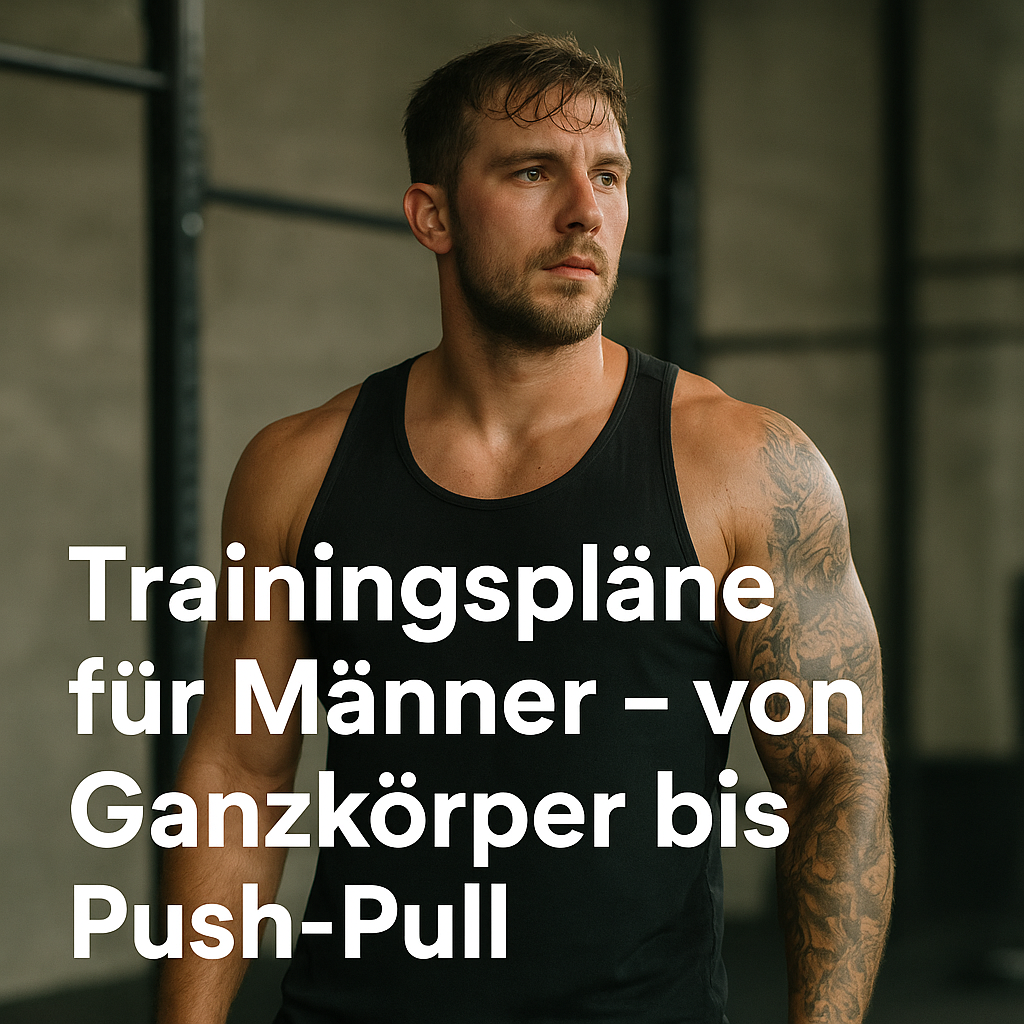
Training plans for men – from full body to push-pull
If you want to make progress at the gym, you need structure. Just jumping in and training without a plan rarely gets you anywhere. A training plan gives your workouts clarity, ensures discipline, and allows you to measure your progress. But which plan is right for you?
Full body plan – the solid starting point
All major muscle groups are trained in one session.
- Suitable for: Beginners, men with little time
- Training frequency: 2-3 times per week
- Advantage: Rapid progress, simple structure
2-day split – upper body and lower body
The training is divided into two areas: upper body and lower body.
- Suitable for: Men with 3-4 training days per week
- Training frequency: 3-4 times per week
- Advantage: More volume and focus, yet still easy to understand
3-day split – classic and intensive
Often divided into chest/shoulders/triceps, back/biceps and legs.
- Suitable for: Advanced athletes who train 4-6 times per week
- Advantage: High specialization, targeted training for each muscle group
4-way split – for ambitious athletes
Even more detailed: e.g., chest, back, legs, shoulders/arms.
- Suitable for: Men who train 5-6 times per week
- Advantage: Maximum intensity per muscle group, compensating for weaknesses
5-way split – almost like bodybuilding
Each day is dedicated to a muscle group, e.g. chest, back, legs, shoulders, arms.
- Suitable for: Very advanced trainees who go to the gym almost daily
- Advantage: Maximum volume per muscle group
- Disadvantage: High time commitment, hardly any flexibility
Push-pull plan – simple and effective
A popular approach where push and pull movements are trained separately. Legs can be integrated or scheduled as a separate day.
- Suitable for: Men with 3-5 training days per week
- Advantages: Clear structure, good balance between upper and lower body, flexibly adaptable
Classes & Gym Programs
Not everyone wants to work with weight training plans – and that's perfectly fine. Group classes are a real game-changer because they combine motivation and structure:
- Bodypump (dumbbell & barbell workouts)
- Functional X / HIIT classes
- Spinning
- Yoga or Power Yoga
Courses are especially good for men who need fixed dates and community to stay motivated.
Clubs & Outdoor Activities
Fitness doesn't end at the gym. Team sports or hobbies keep you fit just as well and should be included in your plan:
- Basketball, football or martial arts train endurance, speed and team spirit.
Mountain biking, swimming or running builds fitness.
Kayaking, windsurfing or golf provide variety and mental balance.
If you regularly do this kind of sport, you can adjust your gym sessions accordingly – nobody has to do everything at once.
Which plan suits you best?
- Beginners, little time: Full body plan
- 3-4 training days: 2-day split or push-pull legs
- Advanced with a clear routine: 3- or 4-day split
- Very ambitious, bodybuilding focus: 5-day split or double push-pull legs over 6 days
- More desire for fun & community: courses or club sports
In the end, it's not the "perfect plan" that matters. What's crucial is that you stick to it regularly and that it fits into your everyday life.
Here's how to create your own plan
-
Define your goal: strength, muscle building, endurance or all-round fitness.
-
Choose the appropriate structure: full body, split or course.
-
Pay attention to a balance between basic exercises (squats, bench presses, pull-ups) and supplementary exercises.
-
Plan in sufficient recovery time.
-
Increase weights or intensity step by step.
If you don't know how to get started: Talk to me directly at FitX in Viersen, send me a message or an email. And if I'm not the right person for you, I know many experienced A-license and personal trainers who can help you progress.
Conclusion
Training plans aren't dogmas, but tools. They help you structure your training, make progress, and stay motivated. Whether it's full-body workouts, split routines, push-pull, classes, or team sports – the most important thing is that you choose the path that fits your life.
- Philipp Krauß