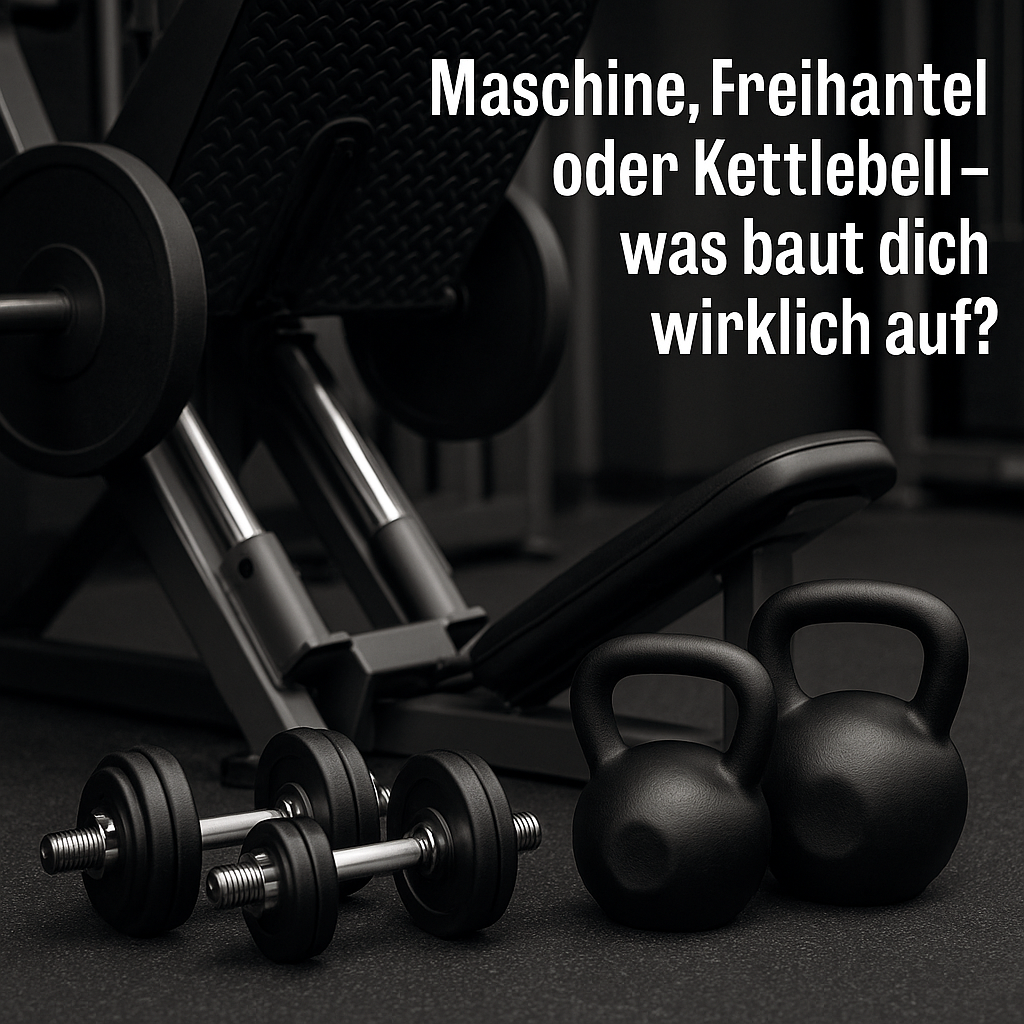
Machine, free weight or kettlebell – what really builds you up?
An honest comparison of systems for muscle building, injury risk and mental effect for men with heart.
When you're standing in the gym, you hear three voices:
The machine whispers: "I will guide you safely."
The free weight demands: "Trust your strength."
The kettlebell says: "Learn the movement, then everything flows."
So, which tools will help you move forward? Here's the honest, scientifically sound answer. Clear, actionable, and without any bro-myths.
1) What does the research say – short & clear
The best overview currently available: A systematic review and meta-analysis (13 studies, n=1016) compared free weights vs. machines for strength, jumping performance, and hypertrophy. Result: No significant difference in muscle growth ; strength gains primarily follow the SAID principle (you get better at what you train). Upper-body strength may have slightly favored machines in some analyses; if you're testing free weight strength, free weight training will yield greater benefits, logically? Conclusion: Both methods work; the choice depends on the goal and context. BioMed Central
Regarding training stimuli , a large network meta-analysis shows that heavier loads are most effective for maximal strength ; for hypertrophy , multiple sets per muscle group are leading, regardless of the type of equipment . This reinforces the thesis that the dose and quality of the stimulus matter more than the tool. (British Journal of Sports Medicine)
The body of research on kettlebells is smaller, but clear: hardstyle movements like swings significantly increase explosive power and maximum strength (e.g., half-squat 1RM) over several weeks. There are also positive effects on functional performance; the evidence for pure hypertrophy is weaker. Europe PMC BioMed Central
2) Muscle building – what really works?
The basic principle is: Muscles grow when you repeatedly train close to the end of your exertion , with sufficient volume throughout the week, adequate protein intake , and adequate recovery . Whether machine, free weights, or kettlebells – all can provide these conditions. The choice primarily determines movement quality, progression, and adherence (sticking with it). The meta-analyses above show that hypertrophy is comparable with the same volume/intensity. BioMed Central British Journal of Sports Medicine
Kettlebells excel in hip-dominant, ballistic movements (swing, clean, snatch). Studies have shown that a 6- to 8-week swing program increases explosive power and 1RM – a strong argument for incorporating kettlebells as a performance booster , even if they are rarely the sole hypertrophy tool. Europe PMC
Practical derivation (hypertrophy):
- Machines : great for stable load progression , isolation work and volume , especially at the end of sets/workouts.
- Free weights : ideal for basic exercises (squat, hinge, press, row) for lots of muscle and lots of progression .
- Kettlebells : Explosive power , body tension , posterior chain and as a metabolic finisher.
3) Risk of injury – how safe are the systems?
Numbers help ground emotions: In the strength sports of weightlifting and powerlifting , injury rates are typically around 1–4 per 1000 training hours , which is low compared to many team or contact sports. The back, shoulder, and knee are frequently affected. (British Journal of Sports Medicine, SpringerLink)
In group-based strength-endurance classes (HIFT style), sometimes higher rates (~9/1000 h) were observed. Note that context, technique coaching, and progression are crucial. If intensity and complexity are too high early on, the risk increases. Mayo Clinic Proceedings
For kettlebells, a scoping review shows that many case reports, few injury cases in the literature, and only a few randomized controlled trials indicate that hard data is scarce. The key takeaway remains: technique and instruction are crucial, especially with ballistic patterns. BioMed Central
What does this mean for the choice of tool?
- Machines reduce the stabilization requirement (guided path), which often helps beginners to load cleanly and limit errors , especially without a spotter. (The reduced stability requirement is well-documented; it is plausible in cases of injury, but indirectly.) BioMed Central
Free weights require more coordination ; EMG studies show, for example, higher stabilizer activity during bench presses with a barbell compared to a Smith machine. More coordination equals a steeper learning curve – and potentially more risk with poor technique. (ResearchGate)
Kettlebells are technical first : A clean hip hinge and timing are essential. With coaching, they are a powerful yet safe tool; without the basics, swings can stress the back. (RCT data even show a reduction in back pain among office workers after 8 weeks of kettlebell training.) Sjögren's Journal
4) Mental effect – stronger in the mind, calmer in the heart
The good news: Strength training significantly reduces depressive symptoms , regardless of age, gender, or health status. This is shown by a large meta-analysis (33 studies, ~1,900 participants). The effects are moderate and occur even without parallel strength gains. JAMA Network
Anxiety levels also decrease with resistance training (RCT data; meta-analyses). Furthermore, there is evidence of improved executive functions (attention/conflict resolution) in older adults. In short, your brain benefits too. SpringerLink Nature JAMA Network
The system question plays less of a mental role than experience and mastery :
- Machines provide security → Self-efficacy increases rapidly through controllable progression.
- Free weights offer autonomy & competence – you “own” the movement.
Kettlebells often create flow : rhythm, breathing, hips – full body tension and presence.
Bottom line: Choose what you train consistently , and the mental benefits will come with routine . (ACSM recommends at least 2 strength training sessions per week as a sensible minimum standard.) ACSM_CMS
5) Practical Blueprint – your roadmap to your goal & everyday life
A) Are you a beginner or returning?
- Goal : Clean movement patterns, basic volume, self-confidence.
- Setup (2×/week, 45–60 min):
- Machine-Lower Body (Leg Press/Leg Curl), Machine-Upper Body (Chest-/Row), Core (Pallof/Plank), + 10 min Kettlebell-Basics (Deadlift-Pattern with KB, then Halos ).
- Progression: 2–3 sets × 8–12 reps , RPE 7–8.
Why: Guided pathways minimize errors, small doses of KB build skills. (Hypertrophy is possible without tool dogma.) BioMed Central British Journal of Sports Medicine
B) You want maximum muscle growth in a limited time?
- Goal : Efficiently demolish large volumes, maintain stable technology.
- Setup (3×/week Push/Pull/Lower):
- Basic free weight exercise (e.g. barbell squat/bench/RDL), followed by machine supersets (isolation), ending with kettlebell finishers (3× 40 on / 20 off swings or carries).
- Volume : 10–20 sets/muscle/week (more is not automatically better).
- Why: Basic exercises for "big stones", machines for stimulus density , KB for explosiveness/metabolism . British Journal of Sports Medicine Europe PMC
C) Is your performance stagnating?
- Goal : To awaken neuromotor skills and explosiveness.
- Setup (2–3 times/week, 15 min power block):
- Kettlebell swings (5x10), rest 60-90 s, then jumping/throwing .
Why: Swings transfer to hip power – exactly what many lack. Europe PMC
D) Are you worried about your back/shoulder?
- Goal : To stress with minimal pain, to develop technique.
- Setup: Machines (e.g. Chest-Supported Row, Hack Squat) + technique-focused KB drills (hinge pattern), increase slowly.
Why: Context creates the risk – stable pathways + coaching reduce it. (HIFT environments show: without progression, the rate increases.) Mayo Clinic Proceedings
6) Technique check – train faster and more safely
- Free weight (example squat): Breath brace, "Screw your feet into the ground", knee over foot, depth you control .
- Machine (leg press): Adjust the seat so that the hips do not "round", brake in a controlled manner at the end of the movement.
- Kettlebell (Swing): Hinge instead of squat; neutral back , power from the hips, loose grip, the kettlebell "floats". (This is the difference between load and back stress.) Sjögren's Journal
7) Conclusion – honest decision-making support
- Muscle building: Machine = free weight = kettlebell, provided the volume/effort is appropriate. Tools are a means to an end . BioMed Central British Journal of Sports Medicine
Strength/Performance: Voice-specific. If you want to be strong in the barbell test → train with barbells. If you want explosive power/hip drive → incorporate kettlebells . BioMed Central Europe PMC
- Safety: Overall low injury rates . Risk increases with poor technique, too rapid progression, and lack of instruction – not with the tool itself. British Journal of Sports Medicine, SpringerLink, Mayo Clinic Proceedings
Mindset: Strength training has an antidepressant and anxiety-reducing effect – the best system is the one you love, learn, and stick with . JAMA Network SpringerLink
Masculogue® credo: Strength without harshness. Discipline with heart. Technique before ego.
Build your body – and your life – brick by brick. We'll be with you every step of the way.
Bonus: 2-week sample plan (3 units/week)
Week 1
- Day A (Push/Power):
LH bench press 4×6 (RPE 7–8)
Shoulder press machine 3×8–10
Dips/Assist 3×AMRAP
KB-Push-Press 5×5 @ quick, clean#
- Day B (Pull):
Pull-ups/Assist 4×6–8
Machine Rowing 4×10
Face Pulls 3×15
KB‑Farmer's Carry 6×30–40 m
- Day C (Lower/Hining):
LH deadlift (RDL) 4×6
Leg press 4x10
Leg curls 3x12
KB‑Swings 8×10 (60–75 s break)
Week 2 : +1 set per main exercise; Swings 10x10. Then deload or increase further. (Adjust volume & sets to your recovery.) British Journal of Sports Medicine
Sources (selection)
-
Haugen ME et al. Free-Weights vs. Machines – Systematic Review & Meta-Analysis (2023). Result: no difference in hypertrophy; strength-specific adaptations according to the SAID principle. BioMed Central
-
Currier BS et al. Resistance training prescription for strength & hypertrophy – Network Meta-Analysis (BJSM). Higher loads for strength, multiple sets for hypertrophy. British Journal of Sports Medicine
-
Lake JP, Lauder MA. Kettlebell Swings Improve Maximum & Explosive Strength (JSCR, 2012). Europe PMC
-
Hing W et al. Kettlebell training in clinical practice – Scoping Review (2019). Evidence is broad, partly limited; safe application with a focus on technique. BioMed Central
-
Keogh JW, Winwood PW et al. / Lindner et al. Injuries in weightlifting/powerlifting – systematic reviews: ~1–4 injuries/1000 h; low compared to contact sports. British Journal of Sports Medicine SpringerLink
-
Mayo Clinic Proceedings: Higher rates in HIFT classes (~9/1000 h) – context and progression matter. Mayo Clinic Proceedings
-
Gordon BR et al. Resistance Training & Depression – Meta‑Analysis (JAMA Psychiatry, 2018). Moderate, robust effect. JAMA Network
-
Gordon BR et al. Resistance Training & Anxiety – Meta-Analysis (Sports Medicine, 2017) + RCT on Anxiety/Worry (2020). SpringerLink Nature
-
ACSM Guidelines: At least 2 strength training sessions per week are recommended. ACSM_CMS
TL;DR
-
Both machines and free weights build muscle – the stimulus is what counts, not the weight. Kettlebells are powerful and skill-intensive , and with proper technique, also suitable for hypertrophy. BioMed Central British Journal of Sports Medicine
-
You'll stay safe with progression, technique, and coaching – not with dogma. British Journal of Sports Medicine, Mayo Clinic Proceedings
-
Mental gains are real – choose the system you love and stick with . JAMA Network